
Glencairn Museum News | Number 9, 2011

Felice Sabatino working on a scale model of a pinnacle.

Figure 1: Bryn Athyn Cathedral altar model.
Visitors who stroll through the stone courtyard and parking area outside Glencairn’s north porch might be surprised to learn what lies beneath their feet. In the underground space once used by the Pitcairn family as a garage is a large storage area filled with thousands of plaster models. The subject matter ranges from complete scale models of the exteriors of Glencairn and Bryn Athyn Cathedral, to full-size models of capitals, figures, ornamentation, and reliefs that were later sculpted in stone, metal, or wood. While some of these pieces would fit in the palm of your hand and still leave room for several more, others measure as large as 8 1/2 by 6 feet.
Raymond Pitcairn’s use of models began several years before ground was broken for Bryn Athyn Cathedral when he built a photography studio across the street from his home at Cairnwood. During the design process for the studio the American illustrator and painter Henry McCarter made a model for Pitcairn “of one of the Gothic clusters of hand-fabricated timber posts with their curved struts or braces. This model took the place of architectural drawings of a complicated feature, which none of us attempted, and it presented the scheme in very palpable form” (Raymond Pitcairn, “Bryn Athyn Church: The Manner of the Building and a Defence Thereof,” 15).
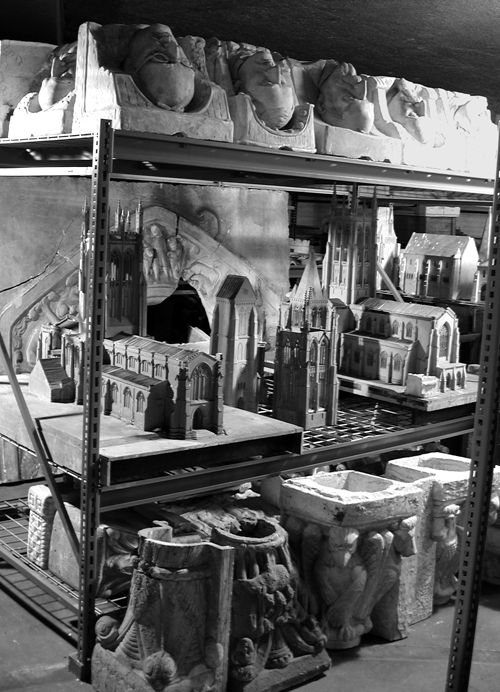
Figure 2: Glencairn Museum storage for plaster models.
While a lack of formal training may have been the initial reason behind Pitcairn’s experiment with modeling, his use of plaster models eventually became an integral part of his design philosophy. Pitcairn agreed with his friend Kingsley Porter, the noted architectural historian, that an overemphasis on “paper architecture” had led to a decline in craftsmanship in the modern era. “In medieval times the man who cut a capital was himself an artist. He designed what he executed. The discovery of paper has made it possible for the architect or his office force to design on paper all the details. The drawings are given to workmen, who copy them mechanically” (Kingsley Porter, Beyond Architecture, 1918, 156). In order to achieve the quality of work that had been produced during the Middle Ages, Pitcairn adopted this approach: “Artistic guidance applied continuously, and designers and craftsmen who work side by side, see eye to eye, and strive ever to build better and to produce work more beautiful, are needed for real building. The use of local materials, the study and development of designs by the aid of tridimensional models, the trial of materials in place before their final building in, and a determination to abandon even finished work if this will lead to something better—all contribute toward building in the Gothic way” (Raymond Pitcairn, “Bryn Athyn Church: The Manner of the Building and a Defence Thereof,” 15).

Figure 3: Individual modeling a capital (Identified as "John G. Young").
Under Pitcairn, creative input was sought from the craftsmen themselves, who worked together with designers in the shops and studios that were built for them on site. Under the direction of Felice Sabatino, a master stone carver trained in Italy, a modeling shop became a crucial part of the design process of both buildings. Some of the trial models now in Glencairn Museum’s collection won Pitcairn’s final approval, in some cases after many re-workings, and were incorporated into the actual structures. Others, once seen in place, were rejected in favor of new concepts. Only after a satisfactory model had been achieved and approved “in place” on the building was it passed on to the craftsmen to be reproduced in stone, wood, or metal.
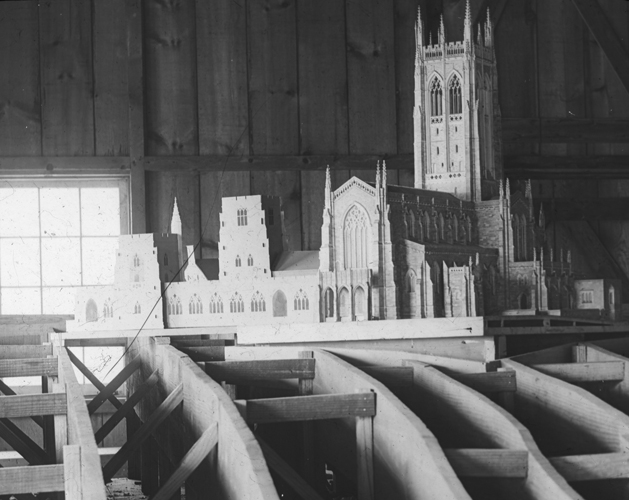
Figure 4: Model of Bryn Athyn Cathedral in the woodworking shop.
Further reading on Raymond Pitcairn’s use of models: Bryn Athyn Cathedral: The Building of a Church, by E. Bruce Glenn, and The Bryn Athyn Historic District, by Ed and Kirsten Gyllenhaal.
(CEG/KHG)
A complete archive of past issues of Glencairn Museum News is available online here.