
Glencairn Museum News | Number 8, 2011
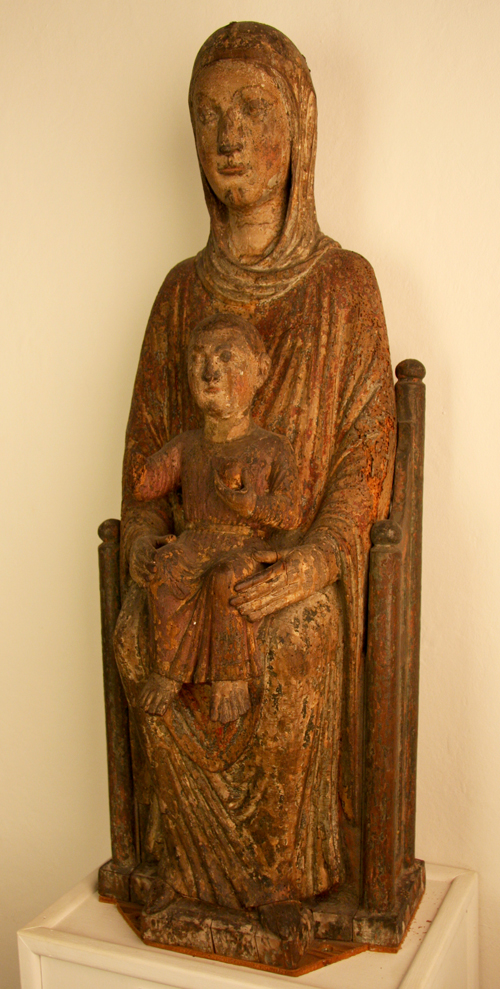
Twelfth-Century statue of Mary and the Christ Child.

Figure 1: View of the Medieval Treasury.
At the end of a long, narrow hall on Glencairn’s fourth floor is the entrance to the Medieval Treasury. A large bay window at the far end of the room allows natural light to stream through an exhibit of magnificent medieval stained-glass panels. The twelfth-century wooden statue of Mary and the Christ Child—the subject of this article—rests on a pedestal nearby.
Mary, her head covered with a closely fitting cloak, is seated on a throne, holding the Christ Child in her lap. His left hand holds an orb, a symbol of His dominion over the world. The right hand of Christ is missing in this statue; based on comparisons with similar sculptures of this genre, it might have been raised in a symbol of blessing. Interestingly, Christ is shown here, not as an infant or playful child, but as a miniature adult (Figure 2). However, this statue was not intended to present a realistic depiction of Mary and the Christ Child; the primary purpose was the expression of theological concepts.

Figure 2: Detail of the Christ Child.

Figure 3: In this side view of the statue, Mary is presented as both the mother of God, holding the child on her lap, and as a throne for the divine wisdom, which is Jesus himself.
For the medieval viewer, this type of statue, referred to by art historians today as the Throne of Wisdom (Figure 3), was a visual presentation of the concept of the Incarnation. Incarnation is a theological term for the process by which Christ took on a human body, while still retaining His divine nature. Mary is here presented as both the mother of God, holding the child on her lap, and as a throne for the divine wisdom, which is Jesus himself. This is a royal image of Christ enthroned with Mary, who was a symbol of the church. He is head of the institution she personifies.
Medieval texts reveal that these statues were used in a variety of ways. They were sometimes placed in churches and shrines along pilgrimage routes, either on the altar or in the sanctuary. They could also be carried through the streets of the town during religious festivals; for instance, these statues are closely associated with the festival of the Epiphany, a celebration of the visit of the three wise men to the Christ Child. Some examples are hollowed out in the back to contain relics, the sacred remains or objects associated with a particular saint. There are even accounts of miracles involving statues like these.
Glencairn’s medieval collection is fortunate to have a number of sculptures depicting Mary and Jesus, including several Romanesque Throne of Wisdom sculptures in the Great Hall. Why not stop by this Saturday afternoon and see how many you can find on your own? Or better yet, why not take the Highlights Tour and learn more about how people from a variety of cultures and time periods have used art to express their religious beliefs and practices?
(MMcE/KHG)
A complete archive of past issues of Glencairn Museum News is available online here.